Folk Art Woven Textile Tote Bag South American Hats Ethnic Peru Cross Body Messenger Shoulder Bag

The Andean textile tradition one time spanned from the Pre-Columbian to the Colonial era throughout the western declension of South America, but was mainly full-bodied in Peru. The arid desert conditions along the coast of Peru take allowed for the preservation of these dyed textiles, which tin date to 6000 years former.[i] Many of the surviving fabric samples were from funerary bundles, however, these textiles also encompassed a diversity of functions. These functions included the use of woven textiles for ceremonial clothing or cloth armor[2] besides as knotted fibers for record-keeping.[3] The textile arts were instrumental in political negotiations, and were used as diplomatic tools that were exchanged between groups.[4] Textiles were also used to communicate wealth, social status, and regional affiliation with others.[v] The cultural accent on the textile arts was ofttimes based on the believed spiritual and metaphysical qualities of the origins of materials used, too every bit cosmological and symbolic messages within the visual appearance of the textiles. Traditionally, the thread used for textiles was spun from ethnic cotton plants, too as alpaca and llama wool.[6]
Origins [edit]
Lithic Catamenia [edit]
The earliest known surviving textiles are samples of fiberwork constitute in Guitarrero Cave, Peru dating back to 8000 BCE.[iii] Early fiberwork by the Norte Chico civilization consisted of institute fibers that were intertwined and knotted to grade baskets and other containers. Surviving examples of finely spun thread and simple cloths signal that knowledge of spinning and weaving had already been well-established and developed in the area.
Mummified man skeletons dating to this flow were stuffed with found fibers and wrapped in rope and pikestaff, a preservation method invented in the Chilean Chinchoros expanse around 5000 BC.[3] Existence of this technology demonstrates early knowledge of spinning naturally occurring fibers into string.
Pre-Ceramic Era [edit]
Littoral civilizations were the showtime to create fishnets, and were the showtime to utilize the openwork tradition in knotted objects. The fishnets were created through twining, a non-loom technique like to macramé.[3] Knotting patterns depicting standing humans, parrots, snakes, and cats accept been decoded from surviving fragments.[5]
Initial Period [edit]
The introduction of camelid herding for their meat, gristly hair, and ability to ship cargo was adult in response to remarkably inhospitable ecology weather establish in Andean highlands. Equally a result, alpacas and llamas were revered for their hardiness and ability to provide resources in both life and expiry.[seven] The scaly fibers produced by these animals were both flexible and dye-permeable, allowing them to be woven with cotton fiber to produce sturdy threads and textiles.
Chavín culture began to sally around the belatedly Initial Period (c. 900-500 BC). Surviving textiles establish from looted burials feature chocolate-brown dye painted on large, seamed panels of cloth. Textiles from the burials of Karwa are featured every bit ritual cult center objects, and depict explicitly feminine deities.[3] The Chavín culture may take demonstrated the first extensive production of textiles for ritualistic and symbolic purposes.
Paracas culture rapidly developed the textile industry into a time-intensive and labor-consuming practise. Embroidered and woven textiles became commonplace,

Late Moche unku shirt fragment.
featuring consistent repetition and variation of motifs. Nonwoven fabric structures, such equally headbands, were created through cantankerous-knit looping.[8] Paracas officials adopted the exercise of wearing multiple garments in sets, including headbands, turbans, mantles, ponchos, tunics, skirts, and loincloths.[5]
The Moche wove textiles, mostly using wool from vicuña and alpaca. Although in that location are few surviving examples of this, descendants of the Moche people have stiff weaving traditions.
Middle Horizon [edit]
The Middle Horizon is characterized by the supremacy of the Wari and Twanaku cultures over the central Andes.
Wari, as the old capital city was called, is located xi km (6.8 mi) north-due east of the modern city of Ayacucho, Peru. This city was the center of a civilization that covered much of the highlands and coast of mod Peru.

The discovery in early on 2013 of an undisturbed majestic tomb, El Castillo de Huarmey, offers new insight into the social and political influence of the Wari during this period. The variety and extent of the burial items accompanying the iii royal women indicate a civilisation with significant cloth wealth and the power to boss a significant part of northern coastal Republic of peru for many decades.[iv]
The Wari are particularly known for their textiles, which were well-preserved in desert burials. The standardization of cloth motifs serves as artistic evidence of state command over elite art product in the Wari state.[7] Surviving textiles include tapestries, hats and tunics for loftier-ranking officials. There are betwixt half-dozen and nine miles of thread in each tunic, and they often feature highly abstracted versions of typical Andean artistic motifs, such as the Staff God. It is possible that these abstruse designs served "a mysterious or esoteric code to keep out uninitiated foreign subjects" and that the geometric distortions made the wearer'southward chest appear larger to reverberate their high rank.[7]
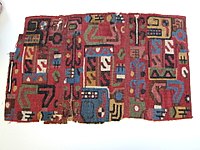
Wari cobweb arts featured large-scale textiles created in state-sponsored workshops. Political messages of abundance and control were depicted using cluttered geometric imagery and camelid-like figures.[7] Examples of surviving imagery (see image) feature multiple repeating motifs of highly geometric patterns, punctuated with highly expressive colour palettes. Scholars have argued that the complication of such designs broadcast the abilities and abundances of state-controlled resources.[6]
Late Intermediate Menses [edit]
Some of the master cultures during the belatedly intermediate period were Lambayeque, Chimor, and Chancay, tardily Cajamarca, Chincha, tardily Chachapoya, Wanka, Chanka, Qolia, Lupaca, Yaro, Warko, and others [3] Lambayeque emerged around the 750 Advertizing, with its peak betwixt 900 Advertizing and 1100. The Lambayeque manner of textiles frequently combined the styles of before cultures, like the Moche and the Wari, just added its own local iconography. This led to a unique style of textile art. These earlier influences from the Wari and Moche include emphasis on narratives. However, Lambayeque'southward local style included motifs such as sea birds and fish, also every bit crescent-shaped headdresses.[3] The Chancay tended to have many different styles in their textiles.These styles included openwork, painted, slit tapestry, and three-dimensional figures. The Chancay textiles tended to utilize soft colors, which contrasts with the Chimú, who used bright, vibrant colors.[3]
Late Horizon (Inca Period) [edit]
Inca cloth played an of import role in both the social and economical foundations of the empire. Material production was, after agriculture, the second largest manufacture in the Inca Empire and was linked to social stratification.
Coarse Cloth – Chusi [edit]
The coarsest course of Inca cloth was chosen chusi. Chusi was non worn, but used for bones household items such as blankets, rugs and sacking. "Individual threads used in this type of fabric were said to sometimes be as thick as a finger.
Standard Cloth – Awaska [edit]
The next grade of Inca weaving was known as awaska. Of all the aboriginal Peruvian textiles, this was the grade near normally used in the production of Inca vesture. Awaska was made from llama or alpaca wool and had a much college thread count (approximately 120 threads per inch) than that found in chusi cloth.
Thick garments made from awaska were worn as standard amongst the lower-classes of the Andean highlands, while lighter cotton clothing was produced on the warmer coastal lowlands. Peruvian Pima cotton, as used by the Incas, is withal regarded as one of the finest cottons available on today's market place.
Textiles of Tawantisuyu's Nobility & Royalty – Qompi [edit]
The finest Inca textiles were reserved for the nobility and the royalty, including the emperor himself. This cloth, known equally qompi (culling spellings cumbi or kumpi), was of exceptionally high quality and required a specialized and state-run trunk of defended workers.
Qompi cloth was produced in state-run institutions chosen aklla-wasi. Here, chosen women (aklla) weaved clothes for the dignity and clergy. A full-time body of male weavers, the qompi-kamayok produced qompi material for the country.
Qompi was made from the finest materials available to the Inca. Alpaca, particularly baby alpaca, and vicuña wool were used to create elaborate and richly decorated items. As a result of their smoothness, Inca textiles made of vicuña cobweb are described every bit "silk" by the first Castilian explorers.
Remarkably, the finest Inca textile had a thread count of more than 600 threads per inch, higher than that plant in contemporaneous European textiles and non excelled anywhere in the world until the industrial revolution in the 19th century.[ix]
Tawantisuyu nationals' costume [edit]
The fashion of Inca clothing was subject to geography. Heavier, warmer materials were mutual in the colder Andean highlands (such as llama, alpaca and vicuna wool, the latter being worn almost exclusively by royalty), while lighter cloth was used in the warmer coastal lowlands (usually cotton). However, the bones design of Inca costume differed picayune throughout the Inca realm, with the quality of the materials and the value of decorative items making almost of the differentiation of the social ranks.
Vesture Worn by Women [edit]
The main detail of Inca vesture worn past women was a long wearing apparel known every bit an anaku (regional difference in manner existed, with the aksu, a longer version of the male person unku, being common). The anaku reached to the wearer's ankles and was held effectually the waist past a broad belt or sash called a chumpi.
A blazon of shawl or mantle, known as a lliclla, was worn over the shoulders. The mantle was attached with tupu pins made of copper, statuary, silver, or gold. The drapery was used every bit a carrying device during the Inca farming process and other daily tasks. Equally was the case throughout the empire, the materials used in the fabrication of all these items depended upon the rank of the wearer.
Article of clothing Worn by Men [edit]
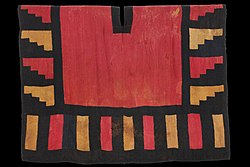
Nasca-Huari ceremonial unku of llama wool, 500 AD-700 AD.
A usually sleeveless shirt or tunic, known as an Unku (or cushma), was the principal particular of men'due south dress. The unku was commonly rectangular in class, all the same variations existed, the unku worn by the people of the Altiplano (Qolla, Lupaca, etc.) was rather trapezoidal for case. The majority of the surviving examples of the unku having a width to length ratio of about seven:9. UIt was about xxx ins (76 cm) wide, reached to just higher up the knee in almost Inca provinces (wamani), and had slits for the head and arms.
Unku varieties worn in some areas of the warmer coastal provinces were much shorter in comparison to typical Inca unku, some reached to merely above the waist (resembling the proportions used by the local ancient desert people such as the Nazca-Paracas), others were hip length, both could be used in tandem with a skirt.
Inca military unku were easily identifiable by their black and white checkered design.
A great deal of recovered Inca unku (shirts and tunics) are from the declension of Peru and Chile, rather than the Andes highlands, due to the climate of the Atacama desert existence much more favorable for textile preservation. Beneath this tunic was worn a breechclout or wara, a type of loincloth, it was exclusively worn past men and consisted of two rectangular strips of material that hung downward from the wearer's waist. Wrapped skirts were worn in some provinces.

Pair of Inca shoes made of camelid wool.
An outer garment chosen a yakkoya (cloak) was worn over the unku. The yacolla was basically a blanket that could be thrown over the shoulders. While working, or dancing, the yacolla was tied over 1 shoulder to keep information technology in place.[10]
Men and women often carried a woven bag known every bit a chuspa. The handbag hung down past the wearer'southward side from a strap about the neck. The purse held such items as coca leaves, personal possessions, slingstones, amid other things.
Male belts were much more than narrow than the waistbands worn by women, and unlike women, information technology was not mandatory for men to clothing them, nevertheless in some provinces belts seem to have been quite pop, however it appears that they did not enjoy much popularity amid the ethnic-Inca dignity of Cusco, judging past the representations of themselves. A hybrid of a belt and a handbag (chuspa) was very popular and commonly worn among the ethnic groups of the Altiplano in the southward of the Empire.
Headdresses were very various in shape and course, many kinds of hats, turbans and headbands, even including things like deer antlers, slings, or cords wrapped around the head were worn. The various headdresses and head adornments indicated the identify of origin of the diverse inhabitants of the Tawantinsuyu. Thus, for instance the Wanka wore a wide blackness headband on their heads, the Chachapoya wore wollen turbans (probably of white color), the Yungas or coastal peoples wore turbans "like those of the gypsies", while the Kana wore bonnets larger than those of the Qolla, those of Cajamarca wore slings on acme of their pilus.[11]
Inca footwear [edit]
Information technology was not uncommon, for many members of society, specially among the lower classes only without excluding the dignity, to spend well-nigh of their fourth dimension bare-footed. Several types of sandals, shoes like in design to Native American moccasins prior to European influence, and high boots worn in the coldest areas, were the types of footwear worn past both men and women. The soles of Inca sandals could be made from leather or woven plant fibers, amongst other materials. The upper role of the sandal consisted of brightly-colored braided woolen cord.
Record-keeping [edit]
Woven textiles [edit]

Manufacturing technique [edit]

A miniature unku shirt for children.
Many textiles, such as baskets and angling nets, did non require the use of a loom. The Andeans used the back strap loom to create woven textiles, every bit chronicled in El primer nueva corónica y buen gobierno. Several techniques were used to produce fabric, including plain weave, tapestry weave, and scroll weave. Smaller woven pieces produced on the same loom were often stitched together to create a larger fabric. Borders of embroidered tunics and mantles are oftentimes busy with yarn tassels or fringe.[12]
Prehistoric Andean weavers pioneered new weaving techniques, such every bit the triple weave and quadruple weave. The use of fine yarn and consistency in stitch size is remarkable, with analyses counting an boilerplate of 250 wefts per inch on average, and some samples exceeding 500 wefts per inch. This is attributed to the regularity in diameter and consistency of thread, as well equally maintenance of tension on the loom throughout the entire weaving process.[2]
A combination of cotton wool and dyed camelid threads contribute structural strength and colorful visual imagery to textiles. The scaly hair of camelids is permeable to dye, allowing natural found-based dyes to be fixed to camelid fibers in the presence of a natural mordant, such equally urine.[13] Complex combinations of coloration and patterning were used to repeat geometric patterns while maintaining visual consistency; Paracas textiles are particularly well known for their regular gridlike arrangement of iconographic images. The consistency of scale and shape of these patterns bespeak to the use of counting systems used by cloth artisans to record the number of stitches and distance between each geometric pattern.[half-dozen]
Workshop production [edit]

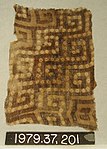
Several different methods of embroidery are attributed to distinctive styles of coloring and depiction of images in woven textiles. Block color, linear, and broad line styles of embroidery imparted different visual effects upon the woven fabric, and were used to convey dissimilar types of information.[5] Designs were too painted directly onto woven textiles using various dyes (see figure).
Professional fabric artisans in pre-Incan cultures ofttimes worked in large workshops with artisans in several specialties. Proximity to other artisans allowed for additional features to be incorporated into plain weave textiles, including metallic threads, knotted strings of feathers, and brocading.[12] Textile painting was mutual practice in the preparation of special cloths for funerary bundles of high-ranking members of social club. Pigments such as ochre and cinnabar take been used for painting textiles since the Early Horizon menstruation.[14]

[edit]
Intricately woven mantles were created to exist worn by nobles and elites, both in life and decease. Mantles were frequently extensive and large, averaging 275 centimeters in length and 130 centimeters in width, and were draped around the neck and over the shoulders.[5] Women fastened fabrics at the front of the body with a tupu, or shawl pin. The size of the mantle and foreshortening furnishings of imagery contributed to the appearance of the wearer equally being "larger than life," serving as explicit condition symbols.[3]
Bright dyes served to distinguish social elite from those of lesser status, as undyed fabric worn past commoners was dark-brown. Chinchero officers wore red ponchos to signify rank during formal authorities occasions.[5] Inca rulers wore a llautu, or tasseled red fringe, on their forehead to demonstrate their status.[xv]
Gifts were also given to conquered territories in ceremonial shows of dominance over the peoples of the region. A region'south power to produce textiles was intricately continued to its success of camelid herding, indicating the value of state-controlled wealth in a territory.[16]
Burial bundles [edit]
Woven garments worn during life indicated an private'south social rank, and were often interred with the individual in death. Gift textiles created expressly for funerary purposes were likewise interred, without being worn in life. Ritual gift objects wrapped in "mummy bundles" include obsidian knives, combs, and balls of thread.[five]
Paracas culture proficient mummification by wrapping the deceased in several layers of woven textiles. Over 429 funeral bundles containing gift textiles, reams of plain fabric, and various ritual paraphernalia take been excavated from a necropolis at Cerro Colorado. These artifacts offer the largest source of pre-Columbian Andean material arts known to date.[5]
Military machine use [edit]
While Andean civilizations had knowledge of and were capable of working metallic, quilted armor was preferred for its light weight and flexibility. Soldiers depicted by Felipe Guaman Poma de Ayala clothing cloth tunics and current of air strips of cloth around themselves to create a sturdy armor that allowed for movement while providing defense. The use of cloth rather than metallic armor was likewise motivated past cultural reasons. The backdrop of cloth were believed to transfer spiritual reinforcement and power to its wearer, supplying force and force.[2]
For similar reasons, woven slings made of plant fibers were the preferred weapons of Moche civilization, rather than stiff wooden or metallic implements.[two] Material blankets and tent-making equipment were readily transportable, allowing caches of resource to be delivered to battle frontiers. Storage warehouses containing fabric equipment accept been excavated throughout Tawantin Suyu. Defeated armies forced to retreat oft burned all cloth unable to be carried, preventing enemy forces from capturing these valuable stashes.[4]
Colonial Period [edit]

The Spanish conquest of the Inca Empire resulted in the clearing of Spanish settlers to the Andean coast. Center- and upper-class Spanish families recognized the value of finely woven native textiles, and demanded luxury textiles to decorate their own homes. As a outcome, cumbi, a fine tapestry material woven from alpaca fibers, was modified to a Spanish color palette and produced for the homes and churches of settlers.[17] The term tornasol refers to the style of textile captivated by Andean weavers subsequently the European context, characterized by a silky texture that appears to change color from different perspectives.[18]
Native weavers modified their technique to produce common items for their colonial audience. Bedcovers, table covers, rugs, and wall hangings became popular textile formats in the late 18th century. European influences introduced lace-inspired borders and stylized circular patterns.[17]
While garments had traditionally been brightly colored and highly patterned, the garments worn by highland Andeans during the Colonial menses were characteristically plain and black. This has been interpreted equally an act of mourning for the lost Inca empire, merely may as well be a consequence of cultural influence imported by arriving Spanish colonists.[eighteen]
In the sixteenth century, Castilian policy makers began recognizing Andean textiles as a marketable article.[xix] Historian Karen Graubart explains in her own work that Spanish policy makers obliged Indian women to make vesture, which would then be sold by their caciques. According to Graubart, this gender division of weaving occurred in the colonial flow because Spanish policy makers causeless that Indian men would be busy with their mitas.[19]
The master buyers of this wear were mitayos, indigenous laborers mostly working in mining areas, and urban Indians. Employers of Indian servants and laborers bought this clothing also because many of them guaranteed outfits in their labor contracts.[xix]
Gallery [edit]




Meet also [edit]
- Mapuche textiles
- Mathematics and art
- Ichcahuipilli
- Textile arts of indigenous peoples of the Americas
- Chuspas
- Chullo
- Lliklla
- Aguayo
Footnotes [edit]
- ^ Tiffany, Leigh Anne (September 16, 2017). "Blue jeans have a half dozen,000 twelvemonth-old Peruvian ancestor". PBS News Hr.
- ^ a b c d Lechtman, Heather. "Technologies of Ability: The Andean Case." In Configurations of Ability: Holistic Anthropology in Theory and Practise, ed. John S. Henderson and Patricia J. Netherly, 254. Ithaca, NY: Cornell University Printing, 1993.
- ^ a b c d e f g h i Stone, Rebecca R. (2012). Art of the Andes: From Chavin to Inca. New York: Thames & Hudson. ISBN978-0-500-20415-three.
- ^ a b Murra, John V. (Baronial 1962). "Cloth and Its Functions in the Inca State". American Anthropological Association. 64 (4): 710–728. doi:10.1525/aa.1962.64.4.02a00020. JSTOR 667788.
- ^ a b c d e f g h Paul, Anne (1990). Paracas Ritual Attire: Symbols of Authority in Ancient Republic of peru. Norman, Oklahoma: University of Oklahoma Press. ISBN978-0-8061-2230-4.
- ^ a b c Stone-Miller, Rebecca (1992). To Weave for the Sun:Ancient Andean Textiles in the Museum of Fine Arts, Boston. New York: Thames & Hudson. ISBN978-0-500-27793-5.
- ^ a b Townsend, Richard F. (1992). The Ancient Americas : Fine art from Sacred Landscapes. Chicago: Art Institute of Chicago. ISBN978-3791311883. OCLC 26095624.
- ^ "Nasca Cross-Knit Looping - Interweave". Interweave. Feb 14, 2018. Retrieved April 16, 2018.
- ^ Jr, James Eastward. Seelye; Selby, Shawn (August 31, 2018). Shaping Northward America: From Exploration to the American Revolution [3 volumes]. ABC-CLIO. p. 510. ISBN9781440836695.
- ^ Vargas, Carlos A. González (2002). Guaman Poma: testigo del mundo andino (in Castilian). Lom Ediciones. ISBN9789562825603.
- ^ Canseco, María Rostworowski de Diez (2001). Pachacutec Inca Yupanqui (in Spanish). Instituto de Estudios Peruanos. ISBN9789972510601.
- ^ a b "Weaving and the Social World: iii,000 Years of Aboriginal Andean Textiles". artgallery.yale.edu . Retrieved Apr 6, 2018.
- ^ Heckman, Andrea Thousand. (2006). "Colorful Messages: The Revival of Natural Dyes in Traditional Cuzco Textiles". Cloth Society of America Symposium Proceedings.
- ^ Barnard, Hans (2016). "Painted textiles: knowledge and technowledge in the Andes". Ñawpa Pacha. 36 (ii): 209–228. doi:10.1080/00776297.2016.1239831. S2CID 191679423.
- ^ "Male Figurine | Inca | The Met". The Metropolitan Museum of Art, i.east. The Met Museum . Retrieved April 10, 2018.
- ^ "About Andean Textiles – Centro de Textiles Tradicionales del Cusco". www.textilescusco.org . Retrieved Apr vi, 2018.
- ^ a b ""T" is for Cumbi Tapestries: Peruvian Textiles in the Spanish Colonial Home. Julia McHugh, Douglass Foundation Fellow in American Fine art, The Metropolitan Museum of Art, New York". DRESSING THE NEW WORLD . Retrieved April 10, 2018.
- ^ a b Phipps, Elena (2000). "'Tornesol': a Colonial synthesis of European and Andean textile traditions". Fabric Society of America Symposium Proceedings.
- ^ a b c Graubart, Karen B. (2000). "Weaving and the Structure of a Gender Division of Labor in Early Colonial Peru". American Indian Quarterly. 24 (four): 537–561. ISSN 0095-182X.
Sources [edit]
- Paul, Anne (1990). Paracas ritual attire: symbols of authority in ancient Peru. Norman: University of Oklahoma Printing. ISBN978-0806122304.
- Paul, Anne (1985). "The Stitching of Paracas Embroidered Images: Procedural Variations and Differences in Meaning". Res: Anthropology and Aesthetics. 9: 91–100. doi:x.1086/RESv9n1ms20166727. S2CID 193747952.
- Phipps, Elena (2004). The colonial Andes: tapestries and silverwork. New York: The Metropolitan Museum of Art. pp. 1530–1830. ISBN978-1588391315.
- Phipps, Elena (2014). The Peruvian Four-Selvaged Fabric: Ancient Threads/New Directions. Seattle: University of Washington Press. ISBN978-0984755059.
- Pillsbury, Joanne (2002). "Inka Unku: Strategy and Design in Colonial Peru". Cleveland Studies in the History of Art. vii: 68–103.
- Rock-Miller, Rebecca (2002). Art of the Andes: from Chavín to Inca . London: Thames and Hudson. ISBN978-0-500-20363-seven.
- Stone-Miller, Rebecca (1994). To Weave for the Sun: Ancient Andean Textiles in the Museum of Fine Arts, Boston. Boston: Thames and Hudson. ISBN978-0500277935.
External links [edit]
- The Middle for Traditional Textiles of Cusco
- "Reckoning with Mestizaje," Vistas: Visual Culture in Spanish America, 1520-1820.
- "About Andean Textiles," Centro de Textiles Tradicionales del Cusco
Source: https://en.wikipedia.org/wiki/Andean_textiles
0 Response to "Folk Art Woven Textile Tote Bag South American Hats Ethnic Peru Cross Body Messenger Shoulder Bag"
Post a Comment